May 4, 2008...2:27 pm
If you get to call us separatists, then we get to call you Evil Empire.
How do you say indépendentiste in English?
There is no word.
This is not trivial. English-speaking journalists will use the Parti Québécois’s terminology and call the party’s supporters sovereignists. In casual conversation the highly pejorative separatist is nearly universal.
But how do you call someone who supports the secession of Québec from the Canadian federation on the general concept of the right to self-determination but who is not necessarily a nationalist or a supporter of the Parti québécois’ (increasignly vague) plan for sovereignty?
These terms are inadequate to reflect the nuances within Québec society on the definition of an independent Québec and it’s political and economic relations with other countries. In English there is only the PQ as the polite face of the radical raving-mad separatists.
As a friend who got tired of being called a separatist once said: Separatist? What do you think this is? Star Wars?
Éric Grenier discussed this in his blog Sovereignty en Anglais a few weeks ago in his post on the tactical debates raging within the Parti Québécois:
“French has a lot of words that simply don’t work well in English. “Référendisme” is one of them. Péquiste (PQ members), adéqiste (ADQ members), bloquiste (Bloc members), are other ones that can’t be directly translated (aydeeque-iste?). “
It is extremely interesting to realize that over 40 years after the creation of the modern Québec independence movement there are still no words in the English language for some of the most basic concepts of the movement’s terminology or even names for the members of Québec’s main political parties.
Is this because an Anglo can only be a Liberal?
Can he only be a Liberal because the independence movement rejects him or is it his community, media and language that unilaterally rejects a whole political movement by not even having words to represent it’s ideas and concepts?
Who is rejecting who is debatable. But the reality is that French Québec, nationalism and even the independence movement has a plurality of political parties and movements, from the far left internationalists of Québec Solidaire to the impatient nationalists of the new Parti indépendantiste (PI, get it?).
Québec’s Anglos somehow never participate in any significant way in any of those movements. Their language excludes them a priori from a “separatist” movement of “pure laine” (notice how the expression “pure laine”, used to make a clear distinction between old-stock French-canadians and other people living in Québec, DID make it into the English vocabulary!) nationalists. They read the Gazette and vote Liberal. Period.
When he saw that 97% of Anglophones had voted against sovereignty in the 1995 referendum Pierre Bourgault concluded: “According to me, 60 to 65% would’ve represented a democratic vote, 80% a xenophobic vote and 97%… that’s simply a racist vote.”
It is not only the English language that has a more limited vocabulary. Take the distinction increasingly made by English-speakers between Quebecer, taken to mean the civic citizenship–the residents of the province of Québec–and the word Québécois, referring to an ethnic group, the French-speaking descendents of New France settlers.
In French, there are no words to make that distinction. Only Québécois. Does that reflect exclusion: there is the Québécois and there is the others? Or does is it illustrate inclusion: all who live in Québec are Québécois?
Perhaps it depends on who you ask.


58 Comments
May 5, 2008 at 1:43 am
Is the purpose of this blog just to vent fury on the maudits Anglais? If so, it’s very off-putting and not very grown-up. But I guess that could describe the sovereignty movement itself.
Let me answer a few rhetorical questions:
“How do you say indépendentiste in English?”
You say “indépendentiste” and everybody knows what you mean. Or you can say “secessionist,” referencing the desire to secede and thus become independent *of* the country seceded from.
“But how do you call someone who supports the secession of Québec from the Canadian federation on the general concept of the right to self-determination but who is not necessarily a nationalist or a supporter of the Parti québécois’ (increasingly vague) plan for sovereignty?”
You call him Daniel, because there is only one of him. Seriously, a sovereigntist/indépendentiste/whateverthehell who is not a Québécois nationalist? I believe there are about eight of them, four in Parliament with the BQ and four in the National Assembly with the PQ. The only Anglos who are pro-secession are living in a strange internationalist past and fantasising about making Quebec like Cuba.
“As a friend who got tired of being called a separatist once said: Separatist? What do you think this is? Star Wars?”
I don’t get the reference. Naboo?
“French has a lot of words that simply don’t work well in English. “Référendisme” is one of them. Péquiste (PQ members), adéqiste (ADQ members), bloquiste (Bloc members), are other ones that can’t be directly translated (aydeeque-iste?).”
Yeah, well, suprise suprise. What’s the French for “neverendum”? “Référendisme” doesn’t count because it’s an ugly neologism that has no place in any self-respecting dictionary. Péquiste and adéqiste are used in English.
“It is extremely interesting to realize that over 40 years after the creation of the modern Québec independence movement there are still no words in the English language for some of the most basic concepts of the movement’s terminology or even names for the members of Québec’s main political parties.”
It is extremely disingenuous to assert that. Quebec English (as spoken by anglophones) is larded with French words and there is no need to invent English equivalents. The myth that English-speaking Quebeckers live in a bubble is obviously so sacred to nationalists that facts have no bearing on it. I lived among Montreal anglos for years and picked up tons of French vocabulary *from them* (i.e. started using it in my everyday English). It was hard to let go of when I left.
“Is this because an Anglo can only be a Liberal?”
Nice non sequitur. These really give the game away, you should cut back on them.
“Who is rejecting who is debatable. But the reality is that French Québec, nationalism and even the independence movement has a plurality of political parties and movements, from the far left internationalists of Québec Solidaire to the impatient nationalists of the new Parti indépendantiste (PI, get it?).”
Yeah, united in their hatred for “the English.” You should be patting the maudits Anglais on the back for bringing you all together.
Would you please stop spelling Quebec “Québec” in English? There is no accent in the English spelling. You know, just like “London” is “Londres” and “Newfoundland” is “Terre-Neuve.”
As to who is rejecting whom, how can the Anglos reject anybody when they are such a small percentage of the population? They have no power to reject anything. Their sole role politically in Quebec is to be the bogeyman for nationalist paranoia. To pretend otherwise is incredibly self-indulgent.
“Québec’s Anglos somehow never participate in any significant way in any of those movements.”
Right, it is not normal for the victims to identify with the persecutors.
“Their language excludes them a priori from a “separatist” movement of “pure laine” (notice how the expression “pure laine”, used to make a clear distinction between old-stock French-canadians and other people living in Québec, DID make it into the English vocabulary!) nationalists. They read the Gazette and vote Liberal. Period.”
They vote Liberal because the Liberals do not campaign against them. They read other newspapers too, but it’s fairly normal to read the local newspaper that’s written in one’s mother tongue. How many francophones read the Globe and Mail regularly? Or the Gazette, for that matter?
“When he saw that 97% of Anglophones had voted against sovereignty in the 1995 referendum Pierre Bourgault concluded: “According to me, 60 to 65% would’ve represented a democratic vote, 80% a xenophobic vote and 97%… that’s simply a racist vote.”
QED. In Bourgault’s formulation (which I can hardly believe that you endorse), a pro-separation vote is pro-pure laine. That’s how the referendum was sold. (Does anyone dare pretend that the “nous” in maîtres chez nous is anything but an appeal to blood? The ADQ has lately been playing that for all it’s worth.) In light of that ugly nativism, obviously the anglophones who were its target would reject it. It’s not racist to vote against racism.
“Take the distinction increasingly made by English-speakers between Quebecer . . .and the word Québécois . . . In French, there are no words to make that distinction. Only Québécois. Does that reflect exclusion: there is the Québécois and there is the others? Or does is it illustrate inclusion: all who live in Québec are Québécois?”
As you imply, it’s deliberately ambiguous, thus appealing both to racists and to anti-racists among French-speakers. This allows the PQ to pretend to be internationalists when they’re really tribalists.
I am so turned off by this post I can hardly say. What’s with the hockey thing? I was listening to the game on English Montreal radio and you can believe me that no anglo Montrealer I ever met would have *dreamed* of cheering for the Flyers. In spite of your excellent English, AFG, I seriously doubt that you know English Montreal — or want to.
May 5, 2008 at 9:07 am
I support Québec’s independence, yet, I am not a nationalist.
May 5, 2008 at 9:30 am
You’re wrong that the Québécois don’t have a word for non pure-laines, it’s “les anglais” or “les ethniques.” And you know that well, unless you are living in a bubble in English West Island. Twice in the past year I have been asked, “Tu n’est pas Québécois, tu viens d’ou”? Some don’t even know I’m an “anglais” — a term I consider an insult — because I have only a slight accent when I speak French and it’s not apparent to everyone that my first language is English.
Are you even aware that our ancestors (I say “our” because my mother is Québécoise) used to call themselves “Canadiens”? But part of the quiet revolution has meant eschewing sharing that name with others across the federation. Even about 25 years ago I met a woman who still called Québécois “les Canadiens” and referred to non Québécois as “les anglais.”
Quebec, by the way, was the name given by the British when they formed this province. Funny how you want to name your republic the same name the British gave you.
BTW Like hoo-boy said, you really don’t need that accent on the word “Quebec” when writing in English. While it instructs the French reader, it means nothing to the English reader. It’s not even a French word; rather, it’s Native, alleged to be Algonqian. And if you know, AFG, what it means, then you are among the very, very few in this land who do. It means “where the river narrows.” How appropriate, when you consider the general course of thought in this province.
May 5, 2008 at 10:06 am
What was up until now a refreshingly atypical blog is now in danger of turning into your run-of-the-mill Quebec-Canada (or Québec-Canada - who cares about accents here, frankly!) online discussion, with the same old arguments we’ve all heard a million times before. Not blaming anyone in particular - je constate tout simplement.
Now, fed-up montrealer, I don’t understand why it is insulting to be called “anglais”? It may be inaccurate (on this I would actually agree with you), but insulting? What’s wrong with being “anglais”? I’ve been called “French” myself by English-speaking Canadians more times than I can remember, and I hear the subset of humanity with which I primarily identify referred to as “the French” all the time. Even though I know this is inaccurate (French people live in France), I don’t really consider it an insult.
“French” and “from Quebec” and “French-speaking” are used interchangeably, so much so that I’ve heard people like Brian Mulroney and Michaëlle Jean referred to as “French” by anglophones!
So yeah, people are showing their ignorance when they used terms like “les anglais” or “the French”, but as the real “anglais” would say, it’s nothing worth getting your knickers in a knot over.
May 5, 2008 at 10:52 am
Sorry if you don’t like that I find being called “un anglais” insulting, acajack, but I do. Especially the way it’s usually said, like when an SQ stopped me at a roadblock once, and when I didn’t understand what he said and politely asked him “Pardon?” he said in a disgusted tone to another cop, “Agh, c’est un anglais!”
I find it insulting because many people really mean it as an insult. And, if they don’t, it’s a way of telling me that I don’t belong, that I’m not Quebecois. Perhaps I’ve heard it far more often than you’ve been called “French,” acajack. But I sure do agree with you when you say “and I hear the subset of humanity with which I primarily identify referred to as ‘the French’ all the time.” I have seen that “subset of humanity” attitude for many of my 53 years, and it has always made me sick and angry at these anglos whenever I heard it. But the truth is I haven’t heard that for a very, very long time. At least, not in Montreal.
I also find it insulting because neither I nor my English-Canadian ancestors had anything to do with the oppression that francophones suffered at the hands of the anglo commercial class of the last century. I’m just a half-bloke, tête-carré (two terms I don’t find insulting — I think they’re clever) who tried to fit in to Quebec society and was and still is rejected as not being pure laine.
And yes, it’s also insulting because I’m not English, I’m Canadian — which, partially for reasons stated above, I prefer to be called. Because Canadians accept me. Quebecois don’t, never have. That’s why I’m one fed-up Montrealer. No matter what we do, it will never be enough.
What you and AFG don’t seem to get is that times have changed and the tables have turned. Today it’s the Quebecois who are the oppressors. You are the new “anglais.”
May 5, 2008 at 11:23 am
You know, as someone who has to go through Westmount, Hampstead, Côte-Saint-Luc or Montreal West to get anywhere in Montreal, I find it quite amusing to be called an oppressor.
May 5, 2008 at 12:11 pm
Fed up montrealer:
It’s not up to me to tell you how to feel or to judge your situation, but it does appear that you have, er… some *issues* with respect to your place in Quebec society. I won’t go any further than that, other than to say that having grown up as a francophone outside Quebec, I could probably fill up this entire blog with juicy anecdotes similar to the one from your SQ stop (and many actually far worse) that spiced up my existence in Anglo-Canada. But I don’t think they would make for the type of interesting discussion that I wish to have here. I only bring them out on “special occasions”, and I don’t think this is one of them. Not yet anyway.
Now, in a broader sociological context, your closing comment about the Québécois now being the oppressors, or the new “anglais”, is very typical of a trend we saw in the late 20th century and into the 21st, whereby the people who dominated society for so long (no bonus points for naming them: white, anglo-saxon males) donned the victim’s cloak in order to counter the uppitiness of all those groups they had under their thumb for so long.
Ah yes, we’ve all heard to yarn… there’s no place in modern society for the white, English-speaking young man, squeezed out by women, aboriginals, black people, francophones, hispanics, etc. Please everyone shed a tear for the North American white anglo male who, although in no way a victim of discrimination, has to suffer the indignity of having to be just as good or better than everyone else in order to succeed, rather than having the world handed to him like an oyster on a silver platter just because of his sex, skin colour and lineage. Boo. Hoo. Hoo.
Finally, please have a check at who is still, some three decades after the adoption of Bill 101, on top of the socio-economic heap in Quebec. Some oppression.
May 5, 2008 at 1:14 pm
“When he saw that 97% of Anglophones had voted against sovereignty in the 1995 referendum Pierre Bourgault concluded: “According to me, 60 to 65% would’ve represented a democratic vote, 80% a xenophobic vote and 97%… that’s simply a racist vote.”
Fedup Montrealer said:
“QED. In Bourgault’s formulation (which I can hardly believe that you endorse), a pro-separation vote is pro-pure laine. That’s how the referendum was sold.”
No it wasn’t. It’s how the English-language media portrayed it. Right image. Wrong messenger.
I would say Bourgault was spot on: 60%-65% of Anglos were reasonnably well informed on the independence project and voted against it because it did not reflect their aspirations. 15% opposed it as a general reflex of rejection of anything francophone, 17% sincerly prefer an order designed for Anglo-Saxon dominance.
To say that one third of Montreal Anglophones are, to this day, somewhere between subconsciously to militantly francophobic, I would not consider that an exageration
May 5, 2008 at 2:35 pm
“To say that one third of Montreal Anglophones are, to this day, somewhere between subconsciously to militantly francophobic, I would not consider that an exageration.”
If there were blogs like this dedicated to attacking my community, I would be francophobic too. Where are the anglo blogs that post racist bullshit like here?
I know there are thousands & thousands of young Québécois out there who are NOT racist and are rejecting tribalism and everything this blog stands for: irredentism, nostalgia, hate. What was I wasting my time here for when I could be talking to them?
May 5, 2008 at 2:49 pm
Don’t know if any of this is being directed at me… and I’ll let others settle scores between themselves.
But for the record I don’t feel that my comments here have stood for irredentism, nostalgia or hate…
Heck, two thirds (white and male) of the target of my latest rant fits me to a T!
May 5, 2008 at 3:02 pm
“To say that one third of Montreal Anglophones are, to this day, somewhere between subconsciously to militantly francophobic, I would not consider that an exageration.”
If there were blogs like this dedicated to attacking my community, I would be francophobic too. Where are the anglo blogs that post racist bullshit like here?”
There are plenty of anglo blogs out there that spout intolerance against francophones. Haven’t you ever heard of Howard Galganov? He’s even something of a folk hero in some Anglo Montreal circles.
And it’s no secret that there is a segment of the Anglo Montreal community that is francophobic, just as there is a segment of the francophone Quebec or Montreal population that is anglophobic. What proportions of the respective populations are indeed “phobic” is difficult to pin down, and trying to speculate on percentages will inevitably get one into big trouble. That’s why I personally tend to avoid associating numbers to sociological phenomena like these, even if I do recognize their existence.
May 5, 2008 at 3:59 pm
“Where are the anglo blogs that post racist bullshit like here?
I know there are thousands & thousands of young Québécois out there who are NOT racist and are rejecting tribalism and everything this blog stands for: irredentism, nostalgia, hate.”
Please quote anything I wrote that was “racist”, “tribal”, “nostalgic” or “hateful”.
As a matter of fact, considering the frequency with with these adjectives are thrown at me and anybody who dares say anything other than: “Canada kicks ass, dude!”, you’d think there’d been an organized campaign to dehumanize French Canadians. Do you think?
Anyway, I still believe my post asked an interesting and valid question: Do you think that beyond language, vocabulary influences our perception of this/these great country/countries?
If you don’t have anything intelligent to say, and only really want to masturbate on ignorance and hate, go read galganov.com or lequebecois.org.
May 5, 2008 at 4:16 pm
AngryFrenchGuy is absolutely correct in attributing the attitude of Anglophone Quebecers regarding Quebec politics to misconceptions entertained by the media of Corporate Canada.
Personal research has lead me to discover that the tactic of the adversaries of the principle of equality of nations to make a philosophical and deeply inspiring struggle for justice appear to be a vulgar contest between races, is in fact quite old.
“All this cry of a hostility to the English race, and a disposition on the part of the Assembly to tyrannize over them, is a mere work of art. ” writes philosopher John Stuart Mill in the London & Westminster Review of December 1838 after reading the Reports of the Gosford Commission. Indeed, the reports had made it quite clear that:
“So long as the contest can be made to appear as one not of nationality but of political principle, the Americans, and a portion even of the British, will be on the democratic side. It is the policy of the leaders of the majority in the Assembly to give the dispute the character of a contest between the aristocratic and the democratic principle rather than one of nationality, and they have succeeded to a great extent;”
It is the local oligarchy, pushing hard to destroy the Representation of Lower Canada, because it was in the majority French-speaking and Catholic, that had an interest in preventing the redress of abuses and the continued violation of the Constitutional Act of 1791 by the Executive and the agents of the British government. The situation was so bad, that the last Colonial Secretary of Lower Canada, Lord Glenelg did not hesitate to affirm:
“The Constitution of 1791, from the earlier years at least in the history of Canada, might be said not to be administered. It might have been very advantageous for the people of Canada if it had been so; but the Executive Government took part with one race, against the other—it took part with the English race, instead of being the umpire and arbitrator between both.”
And what is it that a local oligarchy, owning all English language newspapers but one (The Vindicator) pretending to protect the English minority against a calumniated French majority, stood to lose with the application of the principles of English constitutional government?
Ascendancy.
Of course, had government positions been distributed fairly, the majority of the people would have gotten a proportional share of jobs, of public funds, public contracts, etc. That is a lot of money.
A tiny minority did not accept the split between Upper Canada and Lower Canada designed to avoid complete ascendency of one “race” over the other. It needed to see Anglo-Protestant rule over both Canadas and this meant that the majority of those who used to be the Canadian people had to become a minority inside a monarchical British North America.
The oligarchy had a lot of people on their payroll, so despite being unable to gather popular support using honest methods, they paid the people that needed to be paid to stop the popular Parti patriote.
What does the local oligarchy stand to loose today? Why instil fear of the evil French-speaking majority of Quebec today?
Just imagine the amount of money involved in the very presence of Ottawa’s government inside Quebec and you’ll find your answer. It is still just a question of an “oligarchy, represented by [Ottawa]” and doing “their utmost to inflame those national differences which enable them to identify their cause with that of the [English-speaking Canadians] and even of [all English speakers]”
Hopefully, there were many dissidents in history who ought to be considered heroes, such as Thomas Storrow Brown, who wrote in 1869:
“I had for years been a steady adherent of the Papineau Party, at a pecuniary and social sacrifice, inevitable to him who is separated from those who may be considered his own people, and found in stormy times ranked with an opposing party, alien in blood and language. The reply to that article of the capitulation of 1759, which required safe guard for the Canadians was, “They are subjects of the King.” In 1791, a free Parliament was granted to them, and it appeared to me that manliness in the British people forbade the withholding of any right from a handful of French descent, that the fortunes of war had left in British territory. I saw, too, in their pretensions, the same principle that had been consecrated by the triumphs of the British Commons in their victories over the “Prerogatives” in time past; and felt that an instinctive dread of French supremacy, which I could not share, alone prevented the entire people from making common cause against such a Government and Colonial Office as we had. There was something excitingly chivalric in devotion to a cause where one had everything to lose and nothing to gain. “
May 5, 2008 at 8:25 pm
IMO, i believe the english institutions, especially the gazette, condition their community to believe that anything that is not liberal/federalist/pro-canada is not acceptable. The gazette seem to be there to polarize the english community against the francophone majoirty and making the english feel like they dont belong. And for a newspaper that seems to talk down about Quebecers and frequently makes ridicoulous accusations such as Quebecers of being ethnic nationalists (despite the fact one of the first PQ MNAs, Jean Alfred, was a black man), it seems to be working. It’s sad to see people to this day taking the Gazette’s word at face value.
May 5, 2008 at 9:53 pm
I agree with Acajack on what he calls a “very typical of a trend we saw in the late 20th century and into the 21st, whereby the people who dominated society [...] donned the victim’s cloak”. About this sort of phenomenon…
“Projection is the operation of expelling feelings or wishes the individual finds wholly unexceptable — too shameful, too obscene, too dangerous — by attributing them to another. It is a prominent mechanism, for example, in anti-semites who find it necessary to transfer feelings of their own that they consider low or dirty onto the Jew and then ‘detect’ those feelings in the person projected upon.” — ‘Freud’ by Peter Gay, p.281
“And when you gaze long into an abyss the abyss also gazes into you.” — Friedrich Nietzsche
May 5, 2008 at 9:58 pm
For some reason, I find this post particularly insulting, compared to most others I’ve read.
On the subject of anglo media, specifically the Gazette, I see a lot of hostility among Quebec nationalists directed towards anglo media. The critcism is always the same, there exists a set of national (francophone) values and the Gazette, by focusing on issues that are sometimes opposed to those national values, are themselves being hostile.
Since when does any news organization have a duty to promote the interests of the majority? Do anglos not have the right to have issues that matter to them published?
The most insulting part of the frequent gazette bashing is the apparant view that the poor anglos of Quebec are merely victims of some kind of brainwashing. As though we couldn’t possibly have any complaints about the linguistic issues of Quebec, were it not for the anglo media. I rarely read the Gazette, but when I do, I don’t feel I’m being manipulated.
May 5, 2008 at 10:15 pm
“When he saw that 97% of Anglophones had voted against sovereignty in the 1995 referendum Pierre Bourgault concluded: “According to me, 60 to 65% would’ve represented a democratic vote, 80% a xenophobic vote and 97%… that’s simply a racist vote.”
Racist? Why are the anglos to blame for not supporting the idea? Why is it not the idea itself that is blamed for not being more inclusive? I’m not making either claim myself. Yes, the independance movement is increasingly inclusive, to a point, but not towards anglophones, nor should it be. The principles of the movemnt are necessarily in opposition to the anglo community and not just because the Gazette tells us so.
I’d suggest that if a referendum were held on the question of making Canada an officially english country (or some other fundamental question about language), somewhere in the neighborhood of 97% of the Quebecois population would vote no.
May 5, 2008 at 10:35 pm
“It is not only the English language that has a more limited vocabulary. Take the distinction increasingly made by English-speakers between Quebecer, taken to mean the civic citizenship–the residents of the province of Québec–and the word Québécois, referring to an ethnic group, the French-speaking descendents of New France settlers.
In French, there are no words to make that distinction. Only Québécois. Does that reflect exclusion: there is the Québécois and there is the others? Or does is it illustrate inclusion: all who live in Québec are Québécois?”
As I was reading your post, I was already getting ready to make your above point, so thanks for including it. As for the distinction made by english-speakers, I don’t hear it much, but when I do, I take it as a sign of respect (my apologies if it isn’t received that way). I’ll use Quebecois rather than francophone-Quebecer because I always assumed that francophone-Quebecer was somewhat insulting in that most national majority groups aren’t refered to by hyphenated names.
Whether or not the lack of a distinction in french is a sign of inclusion or exclusion is up for debate. It really depends on who you ask. When the federal government passed the motion that recognized the Quebecois as a nation in the english reading, there was a lot of debate over who was included. The popular idea seemed to be that if you consider yourself Quebecois, then you are. That sounds nice, but I don’t think it’s entirely an individual decision. If I call myself Quebecois and many of the people who are unmistakably Quebecois disagree, then what? When it comes to belonging to a nation, or belonging to any group for that matter, dosn’t it require some kind of consensus? Isn’t the fact that there isn’t consensus proof that some Quebecers don’t belong?
May 5, 2008 at 11:33 pm
Rorybellows: “When it comes to belonging to a nation, or belonging to any group for that matter, dosn’t it require some kind of consensus? Isn’t the fact that there isn’t consensus proof that some Quebecers don’t belong?”
Independence creates consensus. The current situation of a half-born country, competing with a different nationalism from an external entity, creates the confusion.
It is sometimes striking to see the number of things adversaries of sovereignty object to that could actually be solved partly or completely by sovereignty. Other examples…
Relations with minorities: Independence and the sovereignty movement is and has been a positive factor with relations with minorities. In social, economic and other domains, it is when the majority group is in a state of security that tolerance can flourish. Also, Bill 101 has been the single greatest instrument of the contact of cultures in Quebec by bringing the majority and minorities together.
Bill 101: René Lévesque and Camille Laurin have both hinted that Bill 101 (called a “necessary humiliation” by Lévesque) could be weakened or even removed in an independent Quebec. With immigrants clearly knowing they are coming to a predominantly French-speaking country, legislation could become progressively less necessary after achieving sovereignty.
May 6, 2008 at 8:21 am
Just to set the record straight, AFG, you were a little careless in attributing something about Bourgault to me. I didn’t mention him. Such trash talk is really not worth commenting on.
As for your “You know, as someone who has to go through Westmount, Hampstead, Côte-Saint-Luc or Montreal West to get anywhere in Montreal, I find it quite amusing to be called an oppressor.” What a quaint, antiquated idea, that those towns are full of Quebec’s ruling class! Never mind that CSL is middle class, or that francos have been moving into Westmount for years as they’ve gotten wealthier, or that these towns’ wealth is vastly outweighed by those of the new pure-laine suburbs that ring the city. BTW Where do you live, afg, in the railway yards? That would be the only way to have to go “through” CSL! Oh, and I don’t “go through” — I actually live in — the pain-blanc east end, and I feel the oppression of the masses — not the ruling class, which you well know that that’s what true oppression is about.
May 6, 2008 at 8:51 am
“Oh, and I don’t “go through” — I actually live in — the pain-blanc east end, and I feel the oppression of the masses — not the ruling class, which you well know that that’s what true oppression is about.”
What?!?!? The masses aren’t out to oppress anyone, they’re just trying to survive. It’s an age-old trick of the ruling classes (as you called them) to divide up the masses and have them jostle amongst themselves for survival. It’s very effective, and takes most if not all of the pressure off the ruling class, of course.
BTW, someone may correct me but I believe that Westmount (only about 20% francophone, which is higher than it used to be it is true) still has the highest income by far in Quebec. Second and third (I believe again) are Ville Mont-Royal (Town of Mount Royal) and Chelsea, just outside Gatineau. Both TMR and Chelsea are about 50-50 franco-anglo these days.
May 6, 2008 at 8:59 am
Acajack, so you’re saying it’s poetic justice that your linguistic group oppresses mine because mine oppresses yours outside of Quebec? That kind of thinking is gonna get us miles forward, isn’t it.
You and AFG are typical of everyone in this “nation” who will not see the elephant in the room. Even to the extent of trotting out the argument you phrase about the “(white, anglo-saxon males) donned the victim’s cloak in order to counter the uppitiness of all those groups they had under their thumb for so long.” I guess you assume I’m wealthy, because of course all anglos are. I wonder how you think I could oppress? I’m not even heterosexual!
I don’t see why we can’t get past the past and fix the present. I’m trying to present arguments that we have all been avoiding while you guys trot out the same old, same old, without taking your heads out of the sand to see what might have changed. To say that we have all the wealth is no longer true, and hasn’t been for decades. The pendulum has swung past the point of equilibrium to where we anglos are now fed up. It’s our turn to say enough, and hopefully, when — and if — you get over your inferiority and “humiliation” complex, you can become a self-confident, inclusive and benevolent majority.
May 6, 2008 at 9:09 am
Let me define the ruling class, acujack. The Quebec government. Period. Any non pure laine feels its oppression no matter where they live.
May 6, 2008 at 9:58 am
Fed up of what? We’ll be arguing about the details of cohabitation until my grandkids take up bridge, but I fail to see what rights, protections or safeguards you expect Francophones to give up any time soon.
Unless the whole of North Africa and the entire French-speaking part Belgium move to North America withing the next decade, I fail to see how French-speaking North Americans could ever feel a fraction of the cultural security English-speaking North Americans, and yes that includes Anglo Montrealers, enjoy.
English-montrealers have got to get out of their bubble. Montreal is not outside North America and the world. It does not exist in a parallel universe consisting of 70% francophones and 30% anglos with no outside influence!
May 6, 2008 at 10:48 am
And what would you like us to do? Oh yeah, leave.
May 6, 2008 at 1:11 pm
“Acajack, so you’re saying it’s poetic justice that your linguistic group oppresses mine because mine oppresses yours outside of Quebec? That kind of thinking is gonna get us miles forward, isn’t it.”
Please don’t put words in my mouth. Did I use the word “oppression” or any of its derivatives to describe the situation of francophones outside Quebec? Though it’s perhaps not ideal, I don’t consider their situation today to be oppressive, and I certainly don’t consider anglos in Quebec to be oppressed either.
“You and AFG are typical of everyone in this “nation” who will not see the elephant in the room. Even to the extent of trotting out the argument you phrase about the “(white, anglo-saxon males) donned the victim’s cloak in order to counter the uppitiness of all those groups they had under their thumb for so long.” I guess you assume I’m wealthy, because of course all anglos are. I wonder how you think I could oppress? I’m not even heterosexual!”
????? Please explain to me how being a homosexual automatically excludes someone from hypothetically being an “oppressor”?
“I don’t see why we can’t get past the past and fix the present. I’m trying to present arguments that we have all been avoiding while you guys trot out the same old, same old, without taking your heads out of the sand to see what might have changed. To say that we have all the wealth is no longer true, and hasn’t been for decades. The pendulum has swung past the point of equilibrium to where we anglos are now fed up. It’s our turn to say enough, and hopefully, when — and if — you get over your inferiority and “humiliation” complex, you can become a self-confident, inclusive and benevolent majority.”
By and large, francophones in Quebec are already self-confident, inclusive and benevolent. But they are not a true majority in the sense that you are alluding to as they are part of a larger national entity called Canada, and are in fact constantly reminded of their minority status by Canadians of all stripes, many of which actually live on Quebec territory and practice self-exclusion from Quebec society.
May 6, 2008 at 1:18 pm
“Let me define the ruling class, acujack. The Quebec government. Period. Any non pure laine feels its oppression no matter where they live.”
You are 30 years late with this one I am afraid. Though you may not have noticed, Quebec has changed dramatically. It’s not so conveniently simple as “the French Canadians vs. everyone else” any more. In my circle of friends and neighbours I have lots of “non pure laine” (I am repeating your categorization of them here) people, many of whom are visible minorities, and their take on the issue is usually: “What’s up with Quebec anglos? Why do so many of them not speak French, when they’ve lived here all their lives? You’re living in Quebec! Get with the program! Speak French!”
May 6, 2008 at 3:21 pm
I am not non pure laine, I am pure wool!
May 6, 2008 at 5:08 pm
“And what would you like us to do? Oh yeah, leave.”
Leave if you want… I do not wish it… but to be very honest I do not view the departure of so many anglophones as a bad thing either.
The anglophone community in Quebec regenerate itself by assimilating about 50% of immigrants anyway.
May 6, 2008 at 5:18 pm
ohhh and i absolutely encourage people like Howard Galganov or Tony Kondaks to leave Quebec.
I remember when Galganov announced he was going to leave Quebec, I felt a feeling of joy and victory deep inside of me.
BTW the bastard is back.. now trying to fight french in Ontario.
http://www.galganov.com/
May 6, 2008 at 7:52 pm
Acajack : “…their take on the issue is usually: “What’s up with Quebec anglos? Why do so many of them not speak French, when they’ve lived here all their lives? You’re living in Quebec! Get with the program! Speak French!”
I don’t want to continue to take this thread off topic, so I’ll try to respond to this particular pet peeve of mine while relating it to the theme of the orginal post.
Can we generally say that much of the linguistic debate over the past few decades has really been about allophones and the language group they integrate into? Bill 101 wasn’t about forcing anglophones to assimiltate and I don’t believe it was primarily about preventing teh assimilation of francophones, although that is certainly a concern for many.
Everyone here knows that before 101, the majority of new arrivals attended english school and most probably adopted english as their first language (or second, ahead of french though). The situation created was, as described above, a pur laine vs. the others one. No doubt that for a majority group this would be extremely frustrating, so measures were taken to correct the situation.
If the present linguistic tension is going to be blamed entirely on biased anglo media and its intentional use of language to influence people, then how do you explain the attitudes of non pur-laine francophones like Acajack’s neighbors? It’s an attitude that I have seen for myself. Some of the most vehement deniers of my Quebecoiness were themselves immigrants to the place where my grandparents’ grandparents were born.
So where do they get their perceptions of Quebec society from? Why do they feel justified in telling me to “get with the program” or worse of questioning my belonging to their nation? I can’t even fathom moving to the southern California and telling a hispanic American toe get with the program, unless I watched Lou Dobbs every night. I wouldn’t dream of proudly declaring myself an American, while questioning the status of someone who has centuries old roots in the country, unless it was made clear to me that because I possesed a certain trait (english as a first language) I had a right to make such an arrogrant claim.
It’s no accident that Jacques Parizeau didn’t blame money and the anglo vote. The anglo vote is neither needed nor wanted, apparantly. The ethnic vote, however, is. If I were Acajack’s neighbor I would probably look down on anglo’s too.
May 6, 2008 at 8:21 pm
Something I forgot to include in my previous post: the perception that anglos don’t speak french, as Acajack’s neighbor believes. That, above anything, is used as justification for belittling anglo Quebecers. Its also not true. But most of the people who read JdeM’s piece about the army of unilingual anglos taking over Montreal’s service jobs might not realize that.
Do we still want to blame the Gazette and its “angryphone” (the anglo equivalent of separatist) readers for every linguistic problem in Montreal?
May 6, 2008 at 11:43 pm
Rorybellows says: “The anglo vote is neither needed nor wanted, apparantly. The ethnic vote, however, is.”
Goodness gracious… The anglo vote is *wanted*, but it is not *expected*. People like Lévesque tried to include in speeches references to “growing” numbers of English speakers joining the cause, despite having not that much of a basis, if only to make them feel welcome in advance. But others, I think, feel that, if the wind has been blowing one way for a while, it’s silly to expect and predict it to go the other way next tuesday.
What upsets Quebecers, French-speakers and the allophones Acajack speaks of, is the apparent will of English-speakers to live in ‘aparthood’ from the surrounding society, which they understand as a sign of a lack of respect, or even contempt.
That includes a monolithic voting pattern referred to by Bourgault. It’s not the idea that a majority votes against sovereignty, it is that there seems to be no major effort to consider the question on a democratic basis, where one considers how question can affect the whole of Quebec society, and not only the interests of their own group. Or, how do they say… ah yes, ethnocentrism.
The negative aspects of a political system governed by personal interests have been recognized and documented by such thinkers as Plato, Aristotle and Polybius. It isn’t a better idea here.
May 7, 2008 at 1:28 am
Liberlogos: “Goodness gracious… The anglo vote is *wanted*, but it is not *expected*. People like Lévesque tried to include in speeches references to “growing” numbers of English speakers joining the cause, despite having not that much of a basis, if only to make them feel welcome in advance. But others, I think, feel that, if the wind has been blowing one way for a while, it’s silly to expect and predict it to go the other way next tuesday”
Fair enough. Nobody in the independance movement would refuse the support of an anglo, but they sure wouldn’t change a single aspect of their platform to get it. Nor should they, Parizeau’s “nous”, along with increased support among the “ethnics” ought to be enough.
Liberlogos: “What upsets Quebecers, French-speakers and the allophones Acajack speaks of, is the apparent will of English-speakers to live in ‘aparthood’ from the surrounding society, which they understand as a sign of a lack of respect, or even contempt.
That includes a monolithic voting pattern referred to by Bourgault. It’s not the idea that a majority votes against sovereignty, it is that there seems to be no major effort to consider the question on a democratic basis, where one considers how question can affect the whole of Quebec society, and not only the interests of their own group. Or, how do they say… ah yes, ethnocentrism”
I don’t know that the supposed self-isolation of anglos is apparant, nor do I see it is necessarily an act of hostility in cases where it does exist. I would hope that the Quebecois would understand that wanting to resist assimilation isn’t a sign of contempt for another linguistic group.
But I’m really not convinced that there is a general will among anglos to live apart from the rest of Quebecers. Based on my own anecdotal evidence, anglos typically can speak french to some degree, and are willing to without hesitation in many situations.
But, keeping the myth of a ghettoized community that can’t or won’t speak french is too advantageous for two reasons. 1-Maintaining these attitudes allows the anglos to be vilified for standing in the way of Quebec’s progress. If anglos were seen as open and bilingual, then any attempt to blame the for Quebec’s problems would be based solely on ethnicity. 2-Preventing new arrivals from integrating into the anglophone community is essential to the growth of the francophone majority. Whether it is intentional or not, an immigrant learns that the anglo is a wealthy descendant of an imperialst system (when the immigrant may be arriving from a country where imperialism existed) and that he refuses to learn a second language (when the immigrant is often capable of speaking multiple languages). Who do you expect that immigrant identify with?
Are the voting patterns of anglos are evidence of ethnocentrism? Again, I have to point out that it is possible that the question itself is the product of ethnocentrism. If so, voting against such a question is an individual act of self-interest. Is that wrong? If so, I suggest that none of you should be voting for the BQ, since their presence in parliament doesn’t benefit the majority of Canadians. I don’t presume to know why each anglophone voted no, but I would never suggest that any individual vote can be labeled as an act of racism, so why does the label apply to the collective votes of the whole community?
May 7, 2008 at 7:43 am
English is winning over french in Canada and Quebec.
In 100 years, Montreal is very likely to look like what Ottawa is now: an anglophone city where some people speak french as an ethnic code. French is dying in Canada. Quebec is next. That’s why I am angry.
I don’t know why english people are complaining since they are winning the language war. About 1 billion people in the world know english to some degree. They can go to any tourist place in the world and get served in the native language.
May 7, 2008 at 9:02 am
A few responses to Rory Bellows’ thoughtful points.
“Can we generally say that much of the linguistic debate over the past few decades has really been about allophones and the language group they integrate into? Bill 101 wasn’t about forcing anglophones to assimiltate and I don’t believe it was primarily about preventing the assimilation of francophones, although that is certainly a concern for many.”
Agreed 100% (or 101%!). But of course some people still try to portray Bill 101 as an effort to assimilate anglophones, as you know.
“If the present linguistic tension is going to be blamed entirely on biased anglo media and its intentional use of language to influence people, then how do you explain the attitudes of non pur-laine francophones like Acajack’s neighbors? It’s an attitude that I have seen for myself. Some of the most vehement deniers of my Quebecoiness were themselves immigrants to the place where my grandparents’ grandparents were born.”
Good point. It must indeed be galling. I went to university in Ontario and was quite often told to go back to France by Hungarian-Canadians whose parents came here after the Soviet represssion in 1956, or Indo-Canadians whose parents fled Idi Amin’s Uganda. As someone whose ancestors were here around the time of Samuel de Champlain and what they’re celebrating in Quebec City this summer, I know how you feel.
“So where do they get their perceptions of Quebec society from? Why do they feel justified in telling me to “get with the program” or worse of questioning my belonging to their nation?”
It’s all about socialization. Think about it. Howard Galganov was not born Howard MacKenzie into a Montreal Golden Square Mile family. I believe he is of Russian Jewish origin. Yet he came to espouse (and even embody) the worst (in my opinion) of the anti-French Anglo-Montreal mentality that, thankfully, today is not shared by the majority of that community’s leadership. This happened through socialization. The people I know have been socialized as Quebec francophones, so it’s not surprising that their views can be representative of the range of views you will find across French-speaking Quebec. Opinions are not programmed in one’s gene pool, they are acquired over time.
“Something I forgot to include in my previous post: the perception that anglos don’t speak french, as Acajack’s neighbor believes. That, above anything, is used as justification for belittling anglo Quebecers. Its also not true. But most of the people who read JdeM’s piece about the army of unilingual anglos taking over Montreal’s service jobs might not realize that.”
My neighbours don’t believe that no anglos speak French, only that a significant number of them don’t and are rude about it. We should also wonder where they got this impression… probably partly by seeing certain anglos “in action”, right? Now, it doesn’t usually happen every day but here in Gatineau in the Outaouais, there isn’t a month that goes by that I don’t at least once witness, for example, a pimple-faced teenage girl working in a dépanneur greet a customer with a smiling “Bonjour Monsieur, comment ça va”, only to have the customer reply to her rudely in English (sometimes it’s even with a “Doncha speak English?!?”). OK, I know I live next to Ontario and people are going to blame people from across the river. But more often than not, when I happen to exit the place around the same time as the rude customer, he or she is driving a car with Quebec plates. No doubt that my neighbours and other “francisé” immigrants have witnessed these displays as well.
On the other hand, the impression I have is that people who are from Ontario – unless they are drunk – generally tread very carefully with service staff in Quebec. Often in their minds, they’re in “foreign” territory as soon as they cross the Ottawa River, and would be wont to cause a scene just because someone addressed them in French.
Note also that I lived in a minority francophone setting in Ontario for some 20 years, and although French-language service was usually sorely lacking where I lived (in spite of the fact that about one third of the population was francophone), I never really witnessed any such outbursts from francophones. (And I worked in retail in a whole bunch of places, alongside unilingual anglos.) Francophones outside Quebec (except for Acadians in northern New Brunswick) tend to be very submissive when it comes to language. It does make for a really nice bunch of people… who unfortunately may not be around in a generation or two. But that’s a whole other debate…
“Are the voting patterns of anglos are evidence of ethnocentrism? Again, I have to point out that it is possible that the question itself is the product of ethnocentrism. If so, voting against such a question is an individual act of self-interest. Is that wrong? If so, I suggest that none of you should be voting for the BQ, since their presence in parliament doesn’t benefit the majority of Canadians. I don’t presume to know why each anglophone voted no, but I would never suggest that any individual vote can be labeled as an act of racism, so why does the label apply to the collective votes of the whole community?”
I totally agree with you here. One cannot blame Anglo-Quebecers for voting Non out of self-interest. Who would want to swap a country where you are three quarters of the population to one where you are less than one tenth?
That said, I did find that the media coverage in the anglo media (both inside and outside Quebec) in the last referendum campaign was totally biased and a blatant violation of almost all journalistic principles. It is very apparent when you watch documentaries on the work of journalists during the campaign – one that comes to mind is the excellent Référendum Prise Deux / Referendum Take Two. This film also contains the only evidence to my knowledge of a political penchant on the part of legendary Téléjournal anchor Bernard Derome. Derome is off camera, and he’s getting results from his crew in his earpiece. At one point he gets the news that the SRC’s gurus have confirmed the Non side has won, and Derome lets out a huge sigh and an air of disappointment comes over his face. He then composes himself, the cameras come back on and he delivers the news like a true pro.
It is a truism in anglo circles across this country that francophone journalists are massively in favour of independence, even (to some people’s great dismay) those who are employed by the federally-funded CBC French networks. In 1995, RDI, the French counterpart to Newsworld, was unfairly labelled RD-Oui. But the truth is that, no matter what the reporters’ personal biases may be, the francophone media tell both sides of the story almost flawlessly, with balanced views that the anglo audience is almost never exposed to. I once complained to the CBC because the hosts of the highly respected radio show As it Happens referred to Bloc Québécois MPs as “bozos” in a serious interview with a politician from another party! This stuff is common in the anglo media, where the issue of Quebec’s place in Canada is a black and white, good vs. evil story.
May 7, 2008 at 9:36 am
I was Doncha speak English?!?’d yesterday by a doctor at the Royal Victoria Hospital in dowtown Montreal.
I’ve worked in hospitality and agree with Acajack that English-Canadians tread very carefully with language in Québec. The only exception, people from Ottawa.
I don’t know about the rest of you but something not right is going on in that city. There are Canadians from all over Canada able to communicate decently in French today, yet, I would meet on a daily basis people from Ottawa unable to count to three or understand “toilette” with a french accent. I sometime wondered if there was not an active effort to block French out.
On the other hand, I would almost have to fight Francophones from Ottawa to speak French with them. You hear their accent, you know they hear yours, you tell them: “C’est OK, je parle Français” and they would still throw their hands up: “It’s OK French or English. I don’t care! Really, It’s all the same to me. I don’t mind speaking English!”
I would speculate the bilingualisation of the Federal civil service has left some pretty deep scars in that city.
May 7, 2008 at 10:24 am
quebecois separatiste writes:
“ohhh and i absolutely encourage people like Howard Galganov or Tony Kondaks to leave Quebec.”
News flash: I left Quebec 13 years ago.
I also left http://www.angryfrenchguy.com because it is a censored website.
May 7, 2008 at 10:32 am
As you say, there is a lot of frustration in Ottawa with the federal government’s bilingualism requirements for the public service. The perception in a lot of circles is that only francophones need apply, and that it’s even a make-work project for francos. The lightning rods for this sentiment are the letters section of the Ottawa Sun and CFRA, Ottawa’s only talk radio station, particularly the Lowell Green Show.
There has been great resistance to bilingualism at the municipal level in Ottawa, the fear being that official city bilingualism will lead to the francophone only “closed shop” at city hall that people falsely believe to be already in place in the federal government.
Retail service in French is astonishingly rare as well. When I am in Ottawa with unilingual francophone family members and service staff are forced to trot out their broken French to serve them, invariably they’ll say: “Sorry my French is so bad, but I swear to God, no one EVER asks to be served in French here, so I never get to practise it.” Yeah right.
May 7, 2008 at 2:04 pm
Yé Tony’s back!
So tell us Tony? How is the battle for “freedom of choice” in education and other “fundamental rights” for the 30% of Hispanics in your new home of Arizona going?
Do you have your Partido Igualidad going yet?
May 7, 2008 at 2:11 pm
“I don’t presume to know why each anglophone voted no, but I would never suggest that any individual vote can be labeled as an act of racism, so why does the label apply to the collective votes of the whole community?”
I’m closer to AngryFrenchGuy’s way of putting things, when he says a part of the community voted well-informed, and a for a segment, maybe not so much.
May 7, 2008 at 2:31 pm
“I’m closer to AngryFrenchGuy’s way of putting things, when he says a part of the community voted well-informed, and a for a segment, maybe not so much.”
And to make it absolutely clear, my way of seeing it is that, at the end of the day, MOST anglos WERE well informed and in good faith and that, yes, of course, there were were some uninformed xenophobic francos voting yes for all the wrong reasons.
But the consistently Stalinist voting patterns of some sectors of english Montreal are not indicators of a healthy democratic society.
May 7, 2008 at 2:58 pm
I’ll be happy to return to participating on your forum, angryfrenchguy, if you stop censoring me.
What we can do is this: if you feel that I’ve written something offensive that you don’t want on your site, you can delete it…BUT then mention that you’ve done deleted something I’ve written AND allow me, in a subsequent post, to LINK to what was deleted that I will post somewhere else on the web (such as a page on my Google Docs account). That way what I’ve written won’t offend you or others and I can still write what I want without feeling that I am censored.
Do you agree?
May 7, 2008 at 7:40 pm
shut up tony.
merci
May 10, 2008 at 12:06 am
“I have seen that “subset of humanity” attitude for many of my 53 years, and it has always made me sick and angry at these anglos whenever I heard it. But the truth is I haven’t heard that for a very, very long time. At least, not in Montreal.”
Well, it’s far from dead. I have the privilege of having a first name that is irish and a last name that is very quebecois. This makes me the target of racism from both groups and let me tell you, they dish it out equally. I have been called or heard my friends be called “stupid frenchies” more than I have heard people call people “maudits anglais”. I’ve also been privy to several rants about how terrible one side or the other is. Maybe I move in the wrong crowds, but I seem to run into the “subset of humanity” who rant about how terrible “the French” are more than I run into the one that rants about “les anglais”.
I also find it more than annoying to be asked where I come from just based on my rather uncommon first name, but I’ve learned to relish the opportunity to challenge people’s prejudices. The same way I challenge the prejudices of those who think that I have to fit into a certain rigid category because I identify myself as Quebecoise. Racism is very far from dead on both sides and to say that it’s almost disappeared in its more virulent in the anglophone population of montreal is laughable.
May 10, 2008 at 2:58 pm
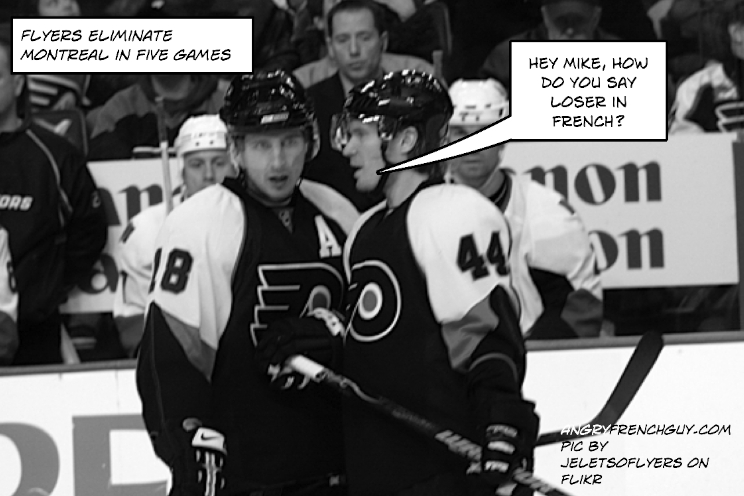
Apropos of both hockey and ethnic designations, readers here might be amused–or even perturbed–to know that during the recent playoff series, Flyers fans routinely used the term “French” to refer both to the Canadiens and to their fans who came down to Philadelphia to cheer them on, even if those fans were English speakers. (I regret also to report that in this connection some Flyers fans used ethnic slurs which I would prefer not to repeat here. I find it ironic that these same fans cheer their lungs out for “Danny” Briere and “Marty” Biron.) Even if you are an English speaking Montrealer, you are “French” enough for many Flyers fans if you wear that Canadiens’ jersey. Just one of the many unforeseen effects of Bill 101, I suppose…
May 11, 2008 at 12:34 pm
The situation in the US is different. The Spanish speaking have never had any language rights, and if somehow they could get them, it would be called PROGRESS. The Quebec English speaking did have those rights, but they were taken away from them, that’s called REGRESS.
And by the way, its IGUALDAD, not IGUALIDAD.
May 11, 2008 at 1:34 pm
Please specify a language right English Quebecers have lost.
May 11, 2008 at 4:37 pm
The right to work in their language and the right to have service in their language, although some of then often receive service in English, it’s not because a law gives them this right.
May 11, 2008 at 5:57 pm
Where is it forbidden for Anglos to work in English? Where is it forbidden for Anglos to give and receive services in English?
May 11, 2008 at 7:32 pm
Language of work of anglophones in Quebec.
French only: 7.1%
Mostly french (some english) : 16.2%
Equal french, english: 10%
Mostly english (some french): 35%
Only english: 31.7%
Source: OQLF latest thousands of pages studies.
Now… who said that english is forbidden at work?
Services? are you joking? In Montreal it is often more difficult to get service in french.
May 11, 2008 at 7:46 pm
Your numbers are probably right, but I’m talking about laws that grant rights, not facts.
An English speaking person doesn’t have the RIGHT to DEMAND English service, and there isn’t a LAW that gives English speakers the right to work in English.
May 11, 2008 at 8:56 pm
So you’d want to trade places with Francophones?
May 11, 2008 at 10:59 pm
so you admit that you are oppressed by ink on papers and not by fact?
May 11, 2008 at 11:55 pm
Oh they have the right to demand service in English, if it’s a federal service. If not… Well, if I went and tried to get service in French in a corner store in Saskatchewan, I doubt I’d get it. I don’t expect to, either. And there is no law saying that private institutions here aren’t allowed to address their customers in English. Most stores I go to, I get service in English, but I do, sometimes, have trouble getting it in French, despite living in a francophone province. So yes, I see how oppressive these laws are.
May 13, 2008 at 3:36 pm
My sense is that the reason you get votes like 97% against separatism is that the Anglo community has zero confidence that an independent Quebec nation would protect their interests. It’s fear that seems like the motivating factor, not racism.
May 13, 2008 at 5:09 pm
I agree with edgy555, in an independent Quebec there wouldn’t be a “Canadian Charter of Rights and Freedoms” or a “Supreme Court of Canada”.
May 14, 2008 at 9:38 pm
Oh jeez, I wish we could just co-exist peacefully. Ironically, the best way to understand each other, is to learn each other languages: english and french. However, learning a language won’t turn one canadian or quebecois. I’m still discriminated against by some unilingual francophones (i say some) so i won’t generalize) because of my faint accent. I was even told off very condescendingly for no reason at all. With that being sad, I’d rather know four languages than only one. Knowing more than one languages is the best thing I’ve ever done including french.
Leave a Reply